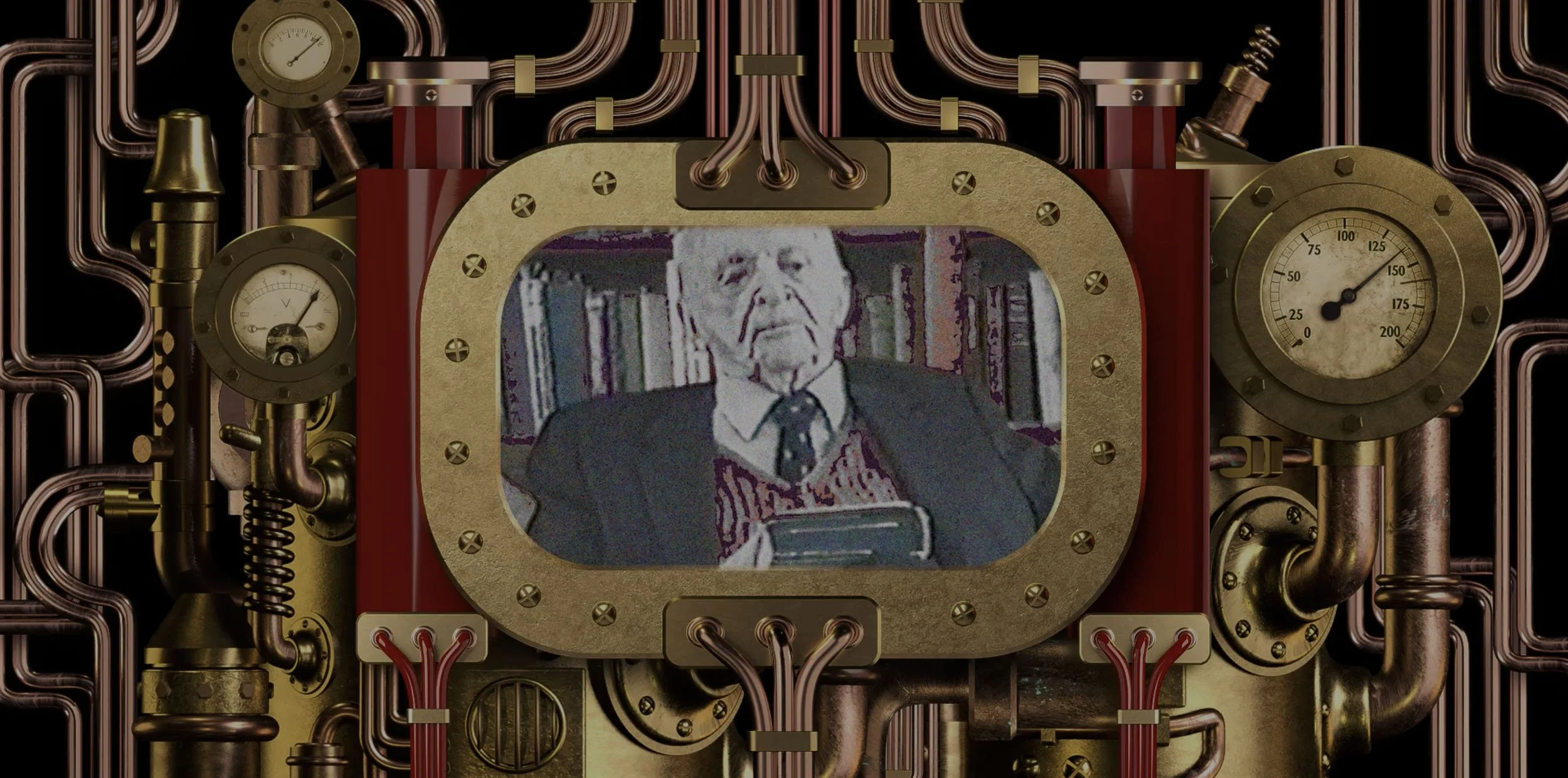
Ask Eddie
Engage Edward L. Bernays in your own conversation
Edward Bernays, or “Eddie,” is widely considered the “Father of Public Relations.” He lived for 103 years and wrote over a million words about the practice and his experience working with some of the country’s leading figures through good times and bad.
Now you can ask him about it yourself and even get his insights into issues concerning you. The material he draws upon includes his writings, speeches, recordings, and interviews. Because he died in 1995, he can’t discuss anything that happened since then. But he does know how to apply timeless principles to modern problems.
How to Ask a Question
Select the microphone icon. Or type your question in the message window.
Introduce yourself. Give your name, title, and company name. Eddie will remember that during your session, but will not remember it once your session is done.
Ask Eddie a question. You can ask about Bernays’s career, writings, reflections on his campaigns, or other aspects of his public relations practice and experiences over the years. Eddie will answer when you stop talking. When Eddie answers, you have the option to hear Eddie speaking in his voice, or turn off his voice by clicking the sound icon at the top of the chat window and just read his answer. You may click the sound icon again to hear Eddie in his voice. Don't be afraid to interrupt Eddie and challenge him on what he's saying.
When you are done with your conversation, say “Goodbye” or click on the End Conversation button to hang up.
If you need to continue your conversation after the 10-minute session limit, feel free to begin a new session. Eddie will not remember the contents of your prior session unless you remind him when rejoining.
You can download a transcript of your conversation by clicking the download button to the right of the microphone button.
If you get a “busy signal.” In the event Eddie is in too many simultaneous conversations at once, your answer may be delayed. But hold on briefly, because his answer to your question will emerge from the queue as soon as possible.
Classroom Guide to Working with “Ask Eddie”
Acknowledgments
“Ask Eddie” was developed in partnership with Edelman, using AI modeling techniques informed by its Archie AI Personas methodology.
If you would like to comment or need assistance with “Ask Eddie,” please let us know.
Guidelines, Terms, Conditions, Privacy, and Sources
PRMuseum Living Archive
Use Guidelines, Terms, Conditions, Privacy, and Sources
About the PRMuseum Living Archive
The PRMuseum Living Archive is an educational initiative of the Museum of Public Relations that uses historically grounded conversational AI to enable users to explore the ideas, experiences, writings, and perspectives of influential figures in the history of public relations and communications.
Living Archive experiences may include Ask Eddie (Edward L. Bernays), Ask Ivy (Ivy Lee), Ask Arthur (Arthur W. Page), Ask Walter (Walter Lippmann) and other historical figures added to the collection over time.
These conversational agents are AI-generated historical interpretations. You are not communicating with the historical person represented, and responses should not be understood as actual statements or quotations by that person.
Responses are generated from historical source materials selected by the PRMuseum and may include inaccuracies, omissions, interpretations, or synthesized language not found verbatim in the original sources.
When accuracy matters, users should consult and cite the original historical materials.
Your Conversations
Conversations with PRMuseum Living Archive agents are recorded and transcribed by the service.
By beginning a conversation, you consent to the recording, transcription, processing, and retention of your conversation by the Museum of Public Relations and its technology service providers for purposes including:
- Operating and improving the PRMuseum Living Archive and other Museum educational programs.
- Maintaining the Museum's historical and research archive.
- Studying how students, educators, practitioners, researchers, and others engage with historical figures, ideas, and materials.
- Educational and scholarly research.
- Developing exhibitions, programs, articles, books, websites, presentations, and other Museum publications and educational materials.
The Museum may retain copies of conversation transcripts, recordings, and associated information in its own archive independently of the technology platforms used to provide the Living Archive.
Please do not disclose confidential, proprietary, legally privileged, highly sensitive personal, or other information that you are not authorized to share.
Use of Conversations in Museum Publications and Programs
The questions people ask—and the conversations those questions produce—can themselves contribute to understanding the history of public relations and communications and the continuing relevance of the people, ideas, events, and ethical questions represented in the Living Archive.
For that reason, the PRMuseum may review Living Archive conversations for possible inclusion in Museum research, educational materials, exhibitions, websites, presentations, articles, books, and other publications.
These may include the proposed publication currently titled Asking Eddie, which may draw upon conversations with multiple historical figures represented in the PRMuseum Living Archive, not only Edward Bernays.
By using a PRMuseum Living Archive conversational agent, you grant the PRMuseum permission to reproduce, quote, excerpt, edit for length or clarity, analyze, and publish de-identified portions of your conversation for these purposes.
When a conversation is published without additional permission, the Museum will take reasonable steps to remove or generalize information that identifies you personally.
The Museum may also remove or generalize names of clients, employers, organizations, individuals, locations, projects, and other details when appropriate to protect privacy or confidentiality.
Permission to publish a de-identified conversation does not give the Museum permission to identify you by name.
If the Museum wishes to identify you by name or other personally identifying information in connection with a published conversation, it will seek your additional permission.
The Museum may also contact you to request additional permission or information concerning a conversation selected for possible publication.
Protecting Other People and Confidential Information
Please remember that your conversation may involve people or organizations other than yourself.
Do not provide confidential client information, trade secrets, privileged communications, non-public business information, private personal information, or information you do not have the right to disclose.
The Museum reserves the right not to publish material that raises privacy, confidentiality, legal, ethical, or other concerns.
Removal of a person's name does not necessarily make information anonymous. The Museum may therefore alter, generalize, or omit additional identifying details before using a conversation publicly.
Where such editing is substantial, the Museum will indicate that identifying details have been removed or changed.
AI-Generated Content
PRMuseum Living Archive responses are AI-generated interpretations, not authenticated primary-source material.
Content may include inaccuracies, omissions, interpretations, or synthesized language not found in original texts. It should not be cited as a primary historical document without verification.
You are welcome to share and reuse Living Archive-generated content for educational and non-commercial purposes, provided that:
- You disclose that it is AI-generated material, not a primary source.
- You acknowledge that AI-generated material may include errors.
- You do not present AI-generated language as an actual quotation from the historical person represented.
- You do not use the service for deceptive or political persuasion.
- You include attribution to the PRMuseum Living Archive and identify the conversational agent used.
- For commercial or promotional use, please contact the PRMuseum.
Users may not independently record, copy, extract, or commercially reproduce the synthesized voices used by PRMuseum Living Archive agents without permission from the PRMuseum.
A transcript of your conversation may be made available at the end of your session.
The PRMuseum may monitor use of the service and suspend access for misuse or violations of these terms.
The service is provided “as is.” The PRMuseum does not guarantee the accuracy or completeness of AI-generated responses and is not responsible for decisions or outcomes based upon them.
Important Guidance for Educators and Students
- Do not cite a PRMuseum Living Archive agent as a primary source.
- Use Living Archive conversations as starting points for analysis, exploration, research, or discussion.
- When accuracy matters, verify information against original historical materials or other authoritative sources.
- Always identify Living Archive material as AI-generated.
- Identify the specific conversational agent when citing or sharing a response.
When sharing transcripts, please include:
“Generated by a historically grounded conversational agent from the PRMuseum Living Archive, an AI-based educational initiative drawing upon archival materials to interpret the ideas and perspectives of figures in the history of public relations and communications.”
How to Cite a PRMuseum Living Archive Conversation
General / APA-style
Museum of Public Relations. (Year). [Agent name] response to “[user prompt]” (PRMuseum Living Archive, AI-generated). Retrieved Month Day, Year, from [URL].
Chicago Style
Museum of Public Relations, [Agent name] response to “[user prompt]” (PRMuseum Living Archive, AI-generated), Month Day, Year, [URL].
MLA Style
Museum of Public Relations. “[Agent name] response to ‘[user prompt].’” PRMuseum Living Archive, AI-generated, Day Month Year, [URL].
In-Text Attribution
([Agent name], PRMuseum Living Archive, AI-generated)
Sources
Each PRMuseum Living Archive conversational agent is grounded in a collection of source materials selected for that historical figure.
Because those collections differ from agent to agent, the sources used for each agent are identified separately below or on that agent's page.
Sources Used in Ask Eddie Responses
Ask Eddie responses are informed by source materials relating to Edward L. Bernays, including:
- Acceptance speech to PR Professionals of Southern New Jersey
- American Public Relations
- Basis of Anglo American Understanding
- Booksellers And His Public
- Counsel on Public Relations
- Crystalizing Public Opinion
- Edward Bernays Emergence of Public Relations Counsel Principles and Recollections
- Edward Bernays Father of PR Not Idle, The Post Palm Beach Florida
- Edward Bernays His Life and His Craft
- Edward Bernays Why We Behave Like Inhuman Beings
- Emergence of the Public Relations Counsel
- Engineering of Consent
- Engineering Public Support For Health and Social Welfare Orgs
- How to Restore Public Confidence in Business and Finance
- Human Engineering and Social Adjustment
- Intelligent experimentation may bring books to wide attention
- Letter About Bill to License
- Morale First Line of Defense
- Manipulating Public Opinion The Why and the How 1928
- Newspaper Censorship
- Propaganda
- Public Relations A Challenge To The Graphic Arts
- Shortage of Pharmacists
- Steps Toward An Adequate U.S. Overseas Information Program
- The Bicentennial Lecture
- The American Press and the Public
- This Business of Propaganda
- The Broadway Anthology
- The Case for PR Licensing
- The Future of Public Relations
- The Integration of Morale
- The Molding of Public Opinion Bernays
- Universities—Pathfinders in Public Opinion: A survey by Edward Bernays and Doris Fleischman
- What Future for Radio Advertising
- Your Future in Public Relations
- Various recordings by Shelley Spector & Barry Spector, 1986–1995